

Avoiding Engine Damage During ECU Tuning: 7 Steps
Table of Contents
- Why ECU Tuning Damages Some Engines and Not Others
- Engine Checks Before ECU Tuning: The Pre-Tune Inspection Checklist
- Safe ECU Tuning for Turbo Engines: Staged Calibration and Supporting Mods
- ECU Tuning Datalogging: What to Monitor During and After a Flash
- Signs of a Bad ECU Tune: When to Stop and Revert
- Choosing a Qualified Tuner and Understanding Warranty and Insurance
- Conclusion: A Safe Tune Is a Monitored Tune
- Frequently Asked Questions
Last Updated: October 11, 2026
Why ECU Tuning Damages Some Engines and Not Others
ECU tuning rewrites the calibration inside your engine control unit to change how the engine makes power. A safe tune respects your existing hardware; a bad tune pushes past it.
At N75 MotorSports, we tune Hyundai and Kia platforms daily, and the pattern is consistent: engines fail rarely.
Three things decide the outcome:
- Engine condition before the flash. A tired motor has no margin.
- Calibration quality. Boost pressure, air-fuel ratio, and ignition timing must stay within safe limits.
- Supporting hardware. Fuel system, cooling system, and oil quality all matter.
Get those three right and tuning is a controlled change. Miss one and you are gambling.
Engine Checks Before ECU Tuning: The Pre-Tune Inspection Checklist
Engine checks before ECU tuning are the most effective way to avoid damage. A tune adds load, heat, and cylinder pressure, stressing every worn part harder.
Run this checklist before you flash anything. For more on why baseline health matters, the U.S. Department of Energy guidance on vehicle maintenance and efficiency explains how maintenance affects how an engine performs under load.
Stage 1: Stop-the-Tune Tests
These tests decide whether the engine is even a candidate. A failure here means no flash.
- Compression test, all cylinders. Record every number, not just "within spec." A spread over about 10 percent between highest and lowest cylinder is a warning sign; a single low cylinder is a hard stop.
- Leak-down test. Confirm where pressure escapes: air past the rings, intake valve, or exhaust valve points to a different repair; bubbles in the cooling system indicate a head gasket or crack.
- Stored and pending fault codes. Scan with a proper tool, not a phone app that only reads emissions codes. Pending codes are early warnings and should be diagnosed, not cleared.
If any Stage 1 test fails, stop. Tuning a motor with a weak cylinder or contaminated oil stresses an already-failing part.
Stage 2: Fuel, Air, and Ignition
A tuned engine needs more fuel, more air, and a reliable spark. If any is marginal, the tune will find the limit.
- Fuel pressure and injector condition. Check static pressure and pressure under load. Dirty or mismatched injectors can make one cylinder run lean while others look fine on a single wideband reading.
- Fuel quality and grade. Confirm the tank holds the octane the tune requires. A tune calibrated for 93 octane run on 87 is a common cause of knock and piston damage.
- Spark plugs. Inspect for fouling, gap wear, and heat range. Replace with plugs one step colder than stock for most boosted applications, gapped to the tuner's spec.
Stage 3: Cooling, Lubrication, and Leaks
Heat and oil quality decide whether a tune survives a track day or a summer commute.
- Cooling system pressure test. Confirm the radiator, hoses, and cap hold pressure. Verify the thermostat opens at the correct temperature and both fans cycle.
- Oil and filter change. Use a quality full synthetic in the manufacturer's grade, or the tuner's recommendation for the power level. Fresh oil gives a clean baseline for the next analysis.
- Oil and fuel leak inspection. Check every joint, seal, and line. A small weep becomes a big problem when boost and heat rise, so replace worn components before they fail under load.
What to Do When a Test Fails
A failed test is not a dead end; it is a repair list. Fix the item, re-test, and only then schedule the tune. Document every result so you and your tuner work from the same data. If a shop cannot show you these results before a flash, that tells you how the tune will be handled.
Safe ECU Tuning for Turbo Engines: Staged Calibration and Supporting Mods
Safe ECU tuning for turbo engines means adding power in stages, not one jump, validating each stage before the next. This is how we approach every Hyundai and Kia build.
A staged process looks like this:
- Baseline run. Log the stock tune to establish reference data.
- Stage 1 calibration. Modest boost and timing changes on stock hardware.
- Validation. Log, review, and confirm everything is in range.
- Supporting mods. Add hardware only when the data shows a limit.
- Stage 2 and beyond. More boost, more fuel, more cooling, validated each time.
Supporting modifications matter more than most people expect.
Oil is part of this too. We recommend our Ultra High 5W40 Performance Engine Oil for tuned N vehicles during track events.
ECU Tuning Datalogging: What to Monitor During and After a Flash
ECU tuning datalogging is how you prove a tune is safe instead of hoping. You record live engine data during real driving and review it for anything out of range.
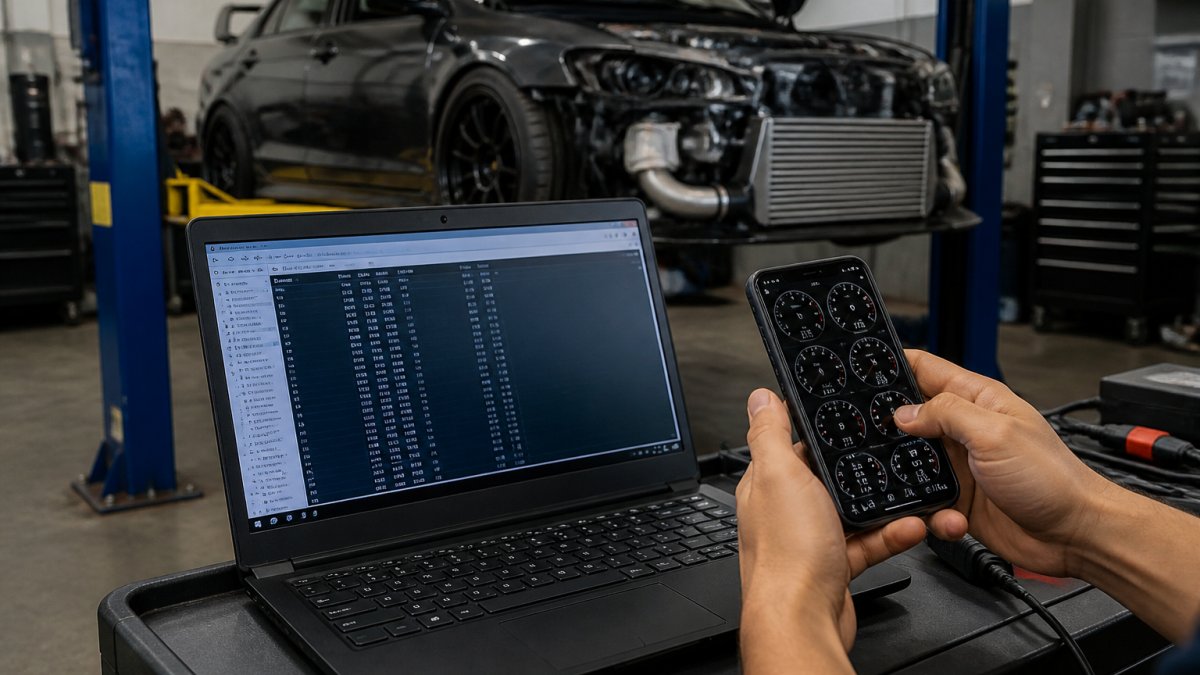
A close-up of hands holding a smartphone displaying a live engine data logging app with multiple gauges, next to a laptop showing tuning software, in a garage with a turbocharged car on a lift in the background
Log a pull in third or fourth gear, from low rpm to redline at wide-open throttle, on a closed course, never on public roads.
The Numbers That Matter Most
Watch these values on every log:
- Air-fuel ratio. Too lean under boost is the fastest route to damage.
- Knock. Any knock events mean back off and investigate.
- Boost pressure. Confirm it matches the target, with no spikes.
A dedicated gauge makes this far easier. Our AEM Digital Wideband UEGO Gauge gives a fast, accurate air-fuel reading in real time. For simpler install, the LUFI OBD2 Multi Display plugs into the OBD port and shows boost, AFR, intake air temp, and custom values with alarms.


Signs of a Bad ECU Tune: When to Stop and Revert
Signs of a bad ECU tune show up quickly if you know what to look for. The right move is always the same: stop, revert to stock, and diagnose. What separates a cheap repair from an engine replacement is how fast you act and whether you preserved a known-safe calibration to fall back on.
AEM Digital Wideband UEGO Gauge 30-4110 →
Symptoms That Mean Stop Driving Now
Pull over and shut the engine off if you experience any of these:
- Audible knock, pinging, or detonation under load
- A flashing check engine light, which usually indicates active misfire
- Sudden loss of power with smoke from the exhaust
A flashing check engine light is not a "drive it home and check later" warning. Continued driving with active misfire can dump raw fuel into the catalytic converter and destroy it, and the misfire may signal a lean condition already damaging pistons.
Symptoms That Mean Stop Tuning and Diagnose
These are less urgent but still mean the calibration is wrong for your car, fuel, or hardware:
- Rough idle, hesitation, or surging at light throttle
- Boost spikes or boost that will not hold the target
- Power that drops off instead of building toward redline
Any one of these means the tune needs review before you keep driving hard. A tuner who reviews datalogs can often revise the file instead of reverting, but only if you stop and send the data.
How to Preserve the Stock Calibration Before You Flash
Do this before the tune, not after a problem, every time.
- Read and save the stock file. Use your flashing tool to pull the factory calibration and store it in two places, such as the device itself and a cloud folder.
- Record the stock file name and checksum. Write it down. If a dealer reflashes the ECU during service, you will need to know which file you started from.
- Confirm the tool can write back to stock. Test the revert process on a day you are not in a hurry, not on the side of the road.
- Keep a known-good tune file. If you run a staged setup, keep the last validated file on the device so you can flash back to it in minutes.
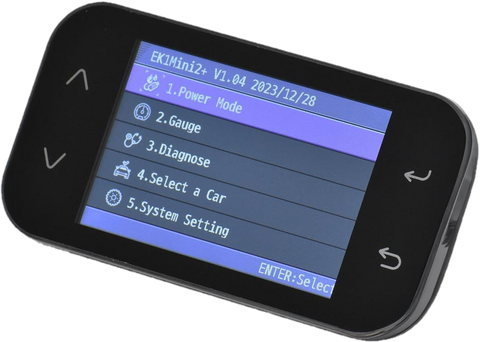
Reverting is straightforward with the right tool. Our EK1 Pro OBD Flash and Logging Device reads, writes, and logs over OBD, stores multiple maps, and lets you flash back to a safer file in minutes. The Transport Canada vehicle safety and defect information is a useful reference if a fault turns out to be a manufacturer issue rather than a tuning one.

EK1 Pro OBD Flash and Logging Device - EK1 Mini is Cheaper option which is currently in stock.
What to Send Your Tuner
A tuner cannot fix what they cannot see. Include:
- The datalog from the pull where the problem appeared, plus one clean pull for comparison
- The exact fuel grade in the tank and the ambient temperature
- Any fault codes, including pending codes
Most tuners will revise the file once and ask for a new log. If the same symptom returns, revert to stock and treat it as a hardware or fuel problem, not a calibration problem.
When to Revert Instead of Revise
Revert to the stock calibration if:
- You cannot reach your tuner and the car is your daily driver
- The symptom appears at part throttle or idle, not just under boost
- You see knock correction on the stock tune as well, which points to a mechanical or fuel issue
Reverting is not a failure; it is a controlled reset that protects the engine while you gather data. A tune you cannot monitor and adjust is not one you should keep.
Choosing a Qualified Tuner and Understanding Warranty and Insurance
A qualified tuner asks about your car before selling you a file. That is the first test.
Ask these questions before you commit:
- Do you inspect the engine before tuning?
- Will you review my datalogs and revise the file?
- What supporting mods do you require for this power level?
If a tuner promises big power with no inspection and no logging, walk away.
Conclusion: A Safe Tune Is a Monitored Tune
The engines that survive tuning are the ones someone actually watched. Pre-tune inspection finds weak points, staged calibration keeps changes controlled, and datalogging proves the result is safe.
That is how we work at N75 MotorSports. We tune Hyundai and Kia platforms in-house, ship every part from our Toronto facility, and support each file with our online tuning portal and cellphone flash tools so you can log, review, and adjust without guesswork.
Get started with N75 MotorSports and tune your car with data behind every change, not hope.
Frequently Asked Questions
Can a bad ECU tune cause engine failure?
Yes. An aggressive tune that pushes boost pressure, ignition timing, or air-fuel ratio past safe limits can cause knock, detonation, or extreme exhaust gas temperatures, which may lead to piston or valve damage. Worn components, poor fuel quality, and a lack of datalogging increase the risk. A safe tune stays within the engine's hardware limits and is validated with real data.
What should I check before tuning a turbocharged engine?
Perform a pre-tune inspection: check for oil and fuel leaks, worn components, and fault codes. Test compression and leak-down, inspect the cooling system and fuel system, and confirm the engine is healthy. Also review maintenance history and ensure you are using the correct fuel grade. This checklist helps avoid engine damage during ECU tuning.
How do I know if my ECU tune is too aggressive?
Watch for signs of a bad ECU tune: knock retard, high exhaust gas temperatures, lean air-fuel ratios, and reduced power after heat soak. If datalogging shows the ECU constantly pulling timing or boost, the tune is too aggressive for your fuel or hardware. Revert to a safer calibration and consult a qualified tuner.
What engine data should I monitor after tuning?
Monitor air-fuel ratio, ignition timing, knock, boost pressure, intake air temperatures, coolant temperature, oil pressure, and exhaust gas temperature. Use datalogging tools like the EK1 Pro or a LUFI OBD2 display to track these values. Consistent monitoring helps you catch problems early and protects engine reliability.